Agentic Workflow Routing: Build an LLM Router in Python (2026)
A code-first routing tutorial: build a runnable LLM router in Python with the Claude API, add a deterministic fallback, and route by difficulty to cut cost.
Updated on August 23, 2026
On this page
Quick Answer
Routing is an agentic workflow pattern where a lightweight classifier reads an incoming request, labels it, and sends it to a specialized handler built for that label. As of July 2026 it is the second of the five patterns in Anthropic's "Building Effective Agents" taxonomy, sitting one step up from prompt chaining. Routing buys you two things: cleaner, more focused prompts per category, and the option to send easy work to a cheap model and hard work to a strong one. This tutorial builds a runnable router in Python with the Claude API, adds a deterministic fallback so an unknown label can never crash the pipeline, and shows the cost-tiered variant that routes by difficulty.
What routing is
Anthropic defines the pattern precisely in Building Effective Agents: "Routing classifies an input and directs it to a specialized followup task. This workflow allows for separation of concerns, and building more specialized prompts."
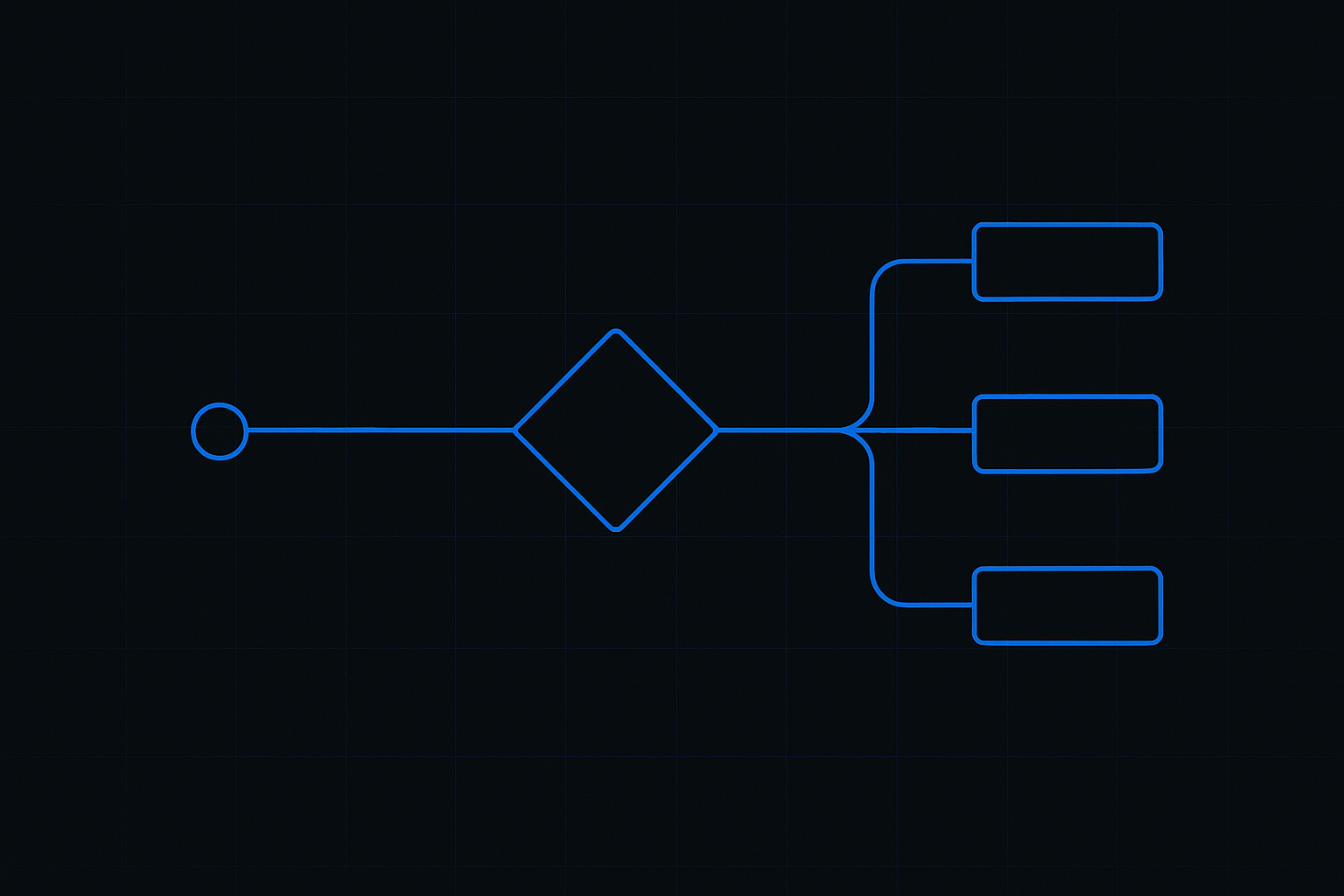
The shape is a fork, not a chain. Prompt chaining runs a fixed sequence of steps for every input. Routing runs a classifier once, then picks exactly one downstream branch. That single decision is the whole pattern. Everything else is engineering the decision so it stays reliable.
                        +-------------------+
   incoming request --> |  router / classify | --(label)-->  branch
                        +-------------------+
                                                    |
                    +-------------------------------+-------------------------------+
                    v                               v                               v
            +---------------+             +-----------------+             +-----------------+
            | billing agent |             | technical agent |             |  general agent  |
            +---------------+             +-----------------+             +-----------------+
When to reach for it (and when not)
Use routing when your inputs fall into distinct categories that are genuinely handled differently, and when the category can be decided reliably. Two cases from Anthropic's writeup make it concrete: directing customer service queries (general questions, refunds, technical support) into separate tools, and routing straightforward questions to a smaller model while sending difficult ones to a stronger model for a better cost/quality trade.
Skip it when the categories bleed into each other. If the classifier is wrong 30% of the time, you have not separated concerns, you have added a failure mode. When boundaries are fuzzy, a single well-written prompt often beats a shaky router. A reliable classifier is the load-bearing assumption of the entire pattern.
Assumptions
- Python 3.10 or newer.
- The official
anthropicSDK:pip install anthropic(1.x line, current as of July 2026). - An API key in the
ANTHROPIC_API_KEYenvironment variable. - Model names below are the current 2026 aliases:
claude-haiku-4-5for cheap, fast classification andclaude-sonnet-5for the hard branch. Check the live Anthropic API reference for the exact model strings and the pricing page for current per-token rates before you ship.
the classifier
The router is one small call. Constrain it hard: give it a closed set of labels and tell it to answer with a single word. A tiny max_tokens keeps it cheap and makes a runaway response impossible.
import os
from anthropic import Anthropic

client = Anthropic(api_key=os.environ["ANTHROPIC_API_KEY"])

ROUTES = ["billing", "technical", "general"]

def classify(request: str) -> str:
    prompt = (
        "Classify the support request into exactly one category.\n"
        f"Categories: {', '.join(ROUTES)}.\n"
        "Reply with ONLY the category word, nothing else.\n\n"
        f"Request: {request}"
    )
    resp = client.messages.create(
        model="claude-haiku-4-5",
        max_tokens=5,
        messages=[{"role": "user", "content": prompt}],
    )
    label = resp.content[0].text.strip().lower()
    # deterministic fallback: an unexpected label can never crash the pipeline
    return label if label in ROUTES else "general"
The last line is the part people skip. A model can return Billing. or technical support or an apology. Validating against the closed ROUTES set and defaulting to general means a bad classification degrades quietly instead of throwing a KeyError three lines later.
the specialized handlers
Each branch gets its own system prompt. This is the payoff Anthropic points at: the billing prompt never has to hedge about refunds it will never see, so it can be sharper.
HANDLERS = {
    "billing": "You are a billing specialist. Be precise about charges, refunds, and invoices.",
    "technical": "You are a senior support engineer. Give exact, reproducible troubleshooting steps.",
    "general": "You are a friendly support agent. Answer clearly and offer a next step.",
}

def handle(request: str, route: str) -> str:
    resp = client.messages.create(
        model="claude-sonnet-5",
        max_tokens=600,
        system=HANDLERS[route],
        messages=[{"role": "user", "content": request}],
    )
    return resp.content[0].text

def route_request(request: str) -> str:
    route = classify(request)
    return handle(request, route)

if __name__ == "__main__":
    print(route_request("I was charged twice for my October invoice."))
Run it. The classifier sees a charge complaint, returns billing, and the billing system prompt answers. Swap in a stack trace and it lands on technical. One decision, one branch.
route by difficulty to cut cost
The second Anthropic example is a pure economics play: classify difficulty, then pick the model. Send the easy 80% to Haiku and reserve Sonnet for the hard 20%.
def classify_difficulty(request: str) -> str:
    prompt = (
        "Is this request simple or hard to answer well?\n"
        "Reply with ONLY 'simple' or 'hard'.\n\n"
        f"Request: {request}"
    )
    resp = client.messages.create(
        model="claude-haiku-4-5",
        max_tokens=5,
        messages=[{"role": "user", "content": prompt}],
    )
    label = resp.content[0].text.strip().lower()
    return label if label in ("simple", "hard") else "hard"  # fail toward quality

def answer(request: str) -> str:
    model = "claude-sonnet-5" if classify_difficulty(request) == "hard" else "claude-haiku-4-5"
    resp = client.messages.create(
        model=model,
        max_tokens=600,
        messages=[{"role": "user", "content": request}],
    )
    return resp.content[0].text
Note the fallback direction flipped: an ambiguous difficulty defaults to hard, because paying for the stronger model is cheaper than shipping a wrong answer. Pick your fallback to fail toward whichever error you can least afford. The same idea works across providers; if you route between vendors, OpenAI's API docs cover the equivalent call shape.
Making the decision reliable
The router is a classifier, so treat it like one.
- Closed label set, always validated. Never index a dict with raw model output. Check membership, then fall back.
- Keep the classifier cheap. A 5-token Haiku call is small next to the handler call, so the router adds latency and cost you barely notice.
- Log the label. When an answer is wrong, you need to know whether the router misfired or the handler did. They are separate bugs with separate fixes.
- Consider a non-LLM router. If a regex or a keyword match classifies reliably, use it. The pattern is about specialized branches, not about spending a token on every decision.
Routing is often the front door to the larger patterns. Once branches start calling each other or looping, you are moving toward orchestrator-workers and evaluator-optimizer, the two heavier patterns in the same taxonomy. Start here, and grow into those only when a single fork stops being enough. For the full map, see our agentic workflow patterns in Python overview, and for the pattern one rung down, the prompt chaining tutorial.
Limitations and open questions
- The classifier is a single point of failure. Every downstream answer inherits its accuracy. Measure classification accuracy on real traffic before you trust the branches.
- Two calls, two latencies. Routing adds a classification round trip. For latency-critical paths, a non-LLM classifier or a cached decision may be worth it.
- Category drift. Real inbound traffic mutates. A route set that fit in January may need a fourth branch by June; budget for periodic review of the label distribution.
- Open question: when does routing beat a single strong prompt? For narrow, high-volume categories the separation clearly helps. For long-tail, overlapping requests the answer is empirical. Log both and compare.
Written by
Ren OkabeRen Okabe builds and breaks agent systems, then writes down the runnable version. Principal-engineer voice, code first.
Frequently asked questions
What is the routing pattern in an agentic workflow?
Routing is a pattern where a lightweight classifier labels an incoming request and directs it to a specialized handler built for that label. Anthropic defines it in Building Effective Agents (2026) as a workflow that classifies an input and sends it to a specialized followup task, which allows separation of concerns and more focused prompts per category.
How is routing different from prompt chaining?
Prompt chaining runs a fixed sequence of steps for every input. Routing runs a classifier once and then picks exactly one downstream branch. Chaining is a straight line; routing is a fork. They are the first two patterns in Anthropic's five-pattern taxonomy and compose well together.
Which model should the router use?
Use a small, fast, cheap model for the classification call itself, for example Claude Haiku 4.5 as of 2026, with a very low max_tokens since it only returns a short label. Reserve a stronger model such as Claude Sonnet 5 for the specialized handler, or for the hard branch when you route by difficulty.
How do I stop a bad classification from crashing the pipeline?
Validate the model's output against a closed set of allowed labels and fall back to a safe default when it does not match. Never index a handler dictionary directly with raw model text, because the model can return punctuation, extra words, or an apology that would raise a KeyError.
When should I not use routing?
Avoid routing when your categories overlap heavily and the classifier cannot decide reliably. If classification is frequently wrong you have added a failure mode instead of separating concerns. For fuzzy, overlapping inputs a single well-written prompt often outperforms an unreliable router.
Related tutorials

Agentic Workflow Patterns in Python (2026)
Five reusable agentic workflow patterns, built from scratch in Python with runnable code and a start-simple rule.
Prompt Chaining in Python: A Runnable Claude Tutorial (2026)
A code-first prompt chaining tutorial: build a gated Python pipeline with the Claude API, add pure-Python and LLM gates, and fail fast before wasting tokens.

LLM as a Judge: Score AI Agent Outputs with Claude (2026)
A minimal, framework-free LLM-as-a-judge harness in Python on Claude: rubric design, pointwise and pairwise scoring, and fixes for position, verbosity, and self-preference bias.